In researching the impact of T cell therapy taking place in medicine around the world, my attitude on understanding effector cell activation has shifted dramatically. Each detail, while tedious to conceptualize while learning the material at home, is a piece of knowledge that brings the scientific community one step closer to providing a cure for cancer. In this blog, I will be sharing some things I’ve learned about the developing research regarding T cell therapy, specifically in its relationship to brain tumors. To help the understanding of this treatment, I’ll first offer a brief explanation to brain tumors themselves. This central nervous system cancer occurs when the DNA in your cells mutate and a group of brain cells begin to divide uncontrollably. The purpose of T cell therapy is to essentially program your own cells to fight off these mutated, uncontrollable cancer cells in the brain tumor.
T cell therapy, if you are unfamiliar, is an amazing process in which a person’s own immune system (specifically their T cell units) are modified in a laboratory setting to fight off cancer. In other words, T cell therapy is essentially programming a person’s body to do the cancer fighting themselves. In looking up T cell therapy with regards to brain tumors, I came across CAR T-cell therapy which specifically has two types– axicabtagene ciloleucel and tisagenlecleucel. Despite their intimidating names, I came to find that the process of CAR T-cell therapy can be explained quite simply.
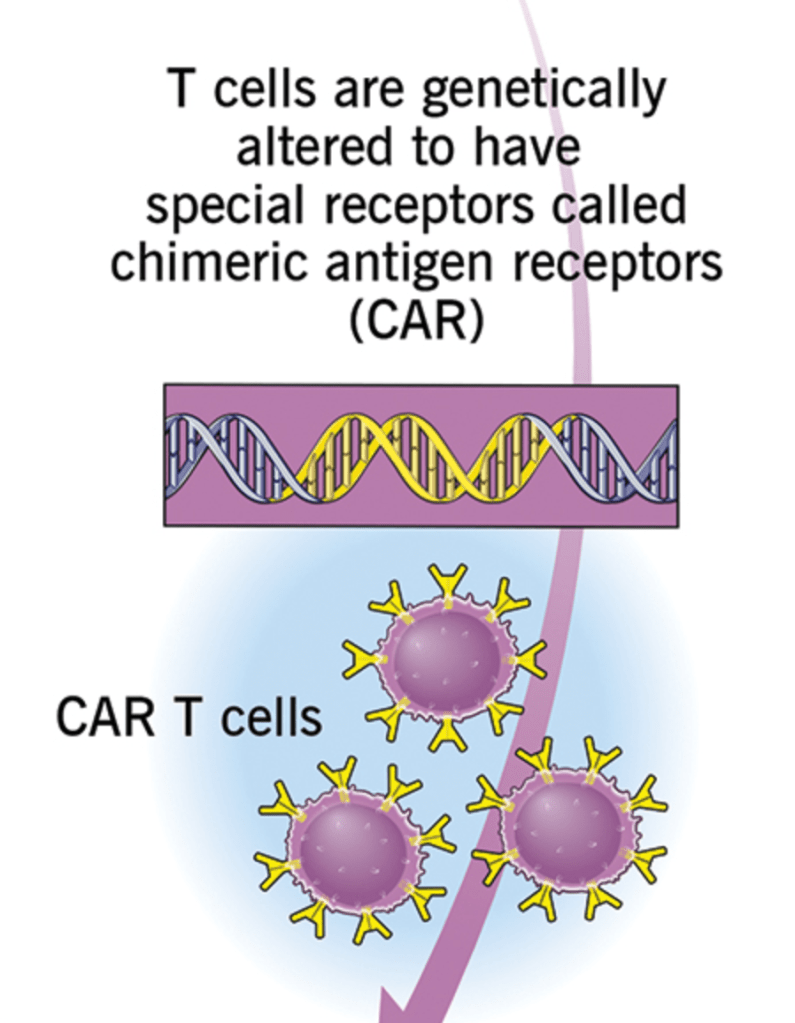
The patient gives a blood sample in which the T cells are removed from the remaining blood cells. Then the T cells receive a specific type of genetic modification (ok, probably not so simple), that gives these cells new receptors called CAR receptors. The patient receives a chemotherapy, and then is presented back with the modified T cells. I was shocked to find that this type of therapy is given in a single treatment. Of course, like all health care in this country, T cell therapy is by no means cheap. The asking price, currently, on this type of therapy is $373,000, with varying reimbursements depending on medicare eligibility. Another con, outside the cost of this therapy, are its side effects. A primarily recognized side effect is the cytokine release that accompanies this therapy, resulting in flu-like symptoms for the patients, usually. Another side effect deals more with neurological function, specifically confusion and impairments speaking. I was personally surprised when reading these side effects, expecting that the implications of re-coding one’s T cells would be far more dangerous and life threatening than the listed side effects appear. After conducting this research, I not only feel more empowered to understand the process of T cells throughout the body, but I also feel compelled to share this data with anyone looking for an answer regarding brain tumor therapy methods.
Extra credit: With regards to COVID-19 cures, it’s undeniable that the world is paused, searching for an answer. Working on what I assume to feel like an emergency time crunch, COVID experts are looking to find fast cures. As a result, a lot of the discoveries that have been made are not empirically proven to work, but are simply guesses. At this point, associations and anecdotal evidence is carrying heavier weight than usual, given the state of such a pandemic. Two drugs being considered specifically are drugs that were used on viruses in the past, specifically on malaria and other diseases that are inflammatory in nature. As of March 24, 2020, only two drugs have offered some type of preliminary result after tireless petri dish testing and manipulation. One drug chloroquine, was studied in China in an experimental setting, and is said to have shown a decrease in pneumonia development in COVID patients.
Another antiviral drug, Remdesivir, has been explored for its potential to have an enzyme that prohibits viruses like COVID 19 from continuing its replication. So far, this drug has shown promising results in the setting of animal testing, facing diseases like SARS that are similar in pathogenesis to COVID 19. Although there is no current cure, there is much to be said behind the closed doors of labs around the world, watching those petri dishes carefully to hopefully bring peace of mind to respiratory systems around the world.

 Kate's MCRO Journey